 Water Filter Finder
Replacement guide
EveryDrop EDR1RXD1 alternatives: how to evaluate generic fridge filter replacements
The EDR1RXD1 fits Whirlpool, KitchenAid, Maytag, JennAir, and Amana fridges — and several generic brands sell compatible cartridges at a third the price. Here's the framework for figuring out which generics are real NSF-certified equivalents and which are just cheaper plastic.
EveryDrop EDR1RXD1 alternatives
The EDR1RXD1 is Whirlpool's OEM replacement filter for a large family of side-by-side and French-door refrigerators across the Whirlpool, KitchenAid, Maytag, JennAir, and Amana brands (Whirlpool owns all of them). At ~$50 per cartridge on a 6-month replacement cycle, that's $100/year per fridge just for the filter — and generic brands sell "compatible" cartridges for $10-$20 each.
This page is about how to tell which generics actually replicate the OEM's filtration performance and which ones just match the form factor. The honest answer involves checking cert databases, not Amazon star ratings.
What an EDR1RXD1 actually does
EveryDrop EDR1RXD1 is the OEM cartridge for a wide set of fridge models. Whirlpool's marketing on the cartridge claims NSF/ANSI 42 (chlorine taste/odor) and NSF/ANSI 53 (lead, cysts, other health-effect contaminants) certification. You can verify the specific certifications on the current SKU at WQA Gold Seal — EveryDrop — search returns the current EveryDrop product listings with the standards they're certified under.
The certification matters because a fridge filter that's certified to NSF/ANSI 53 for lead is genuinely different from one that just physically fits the slot. Lead reduction requires specific activated carbon formulations, contact time, and media density that not all generic manufacturers replicate.
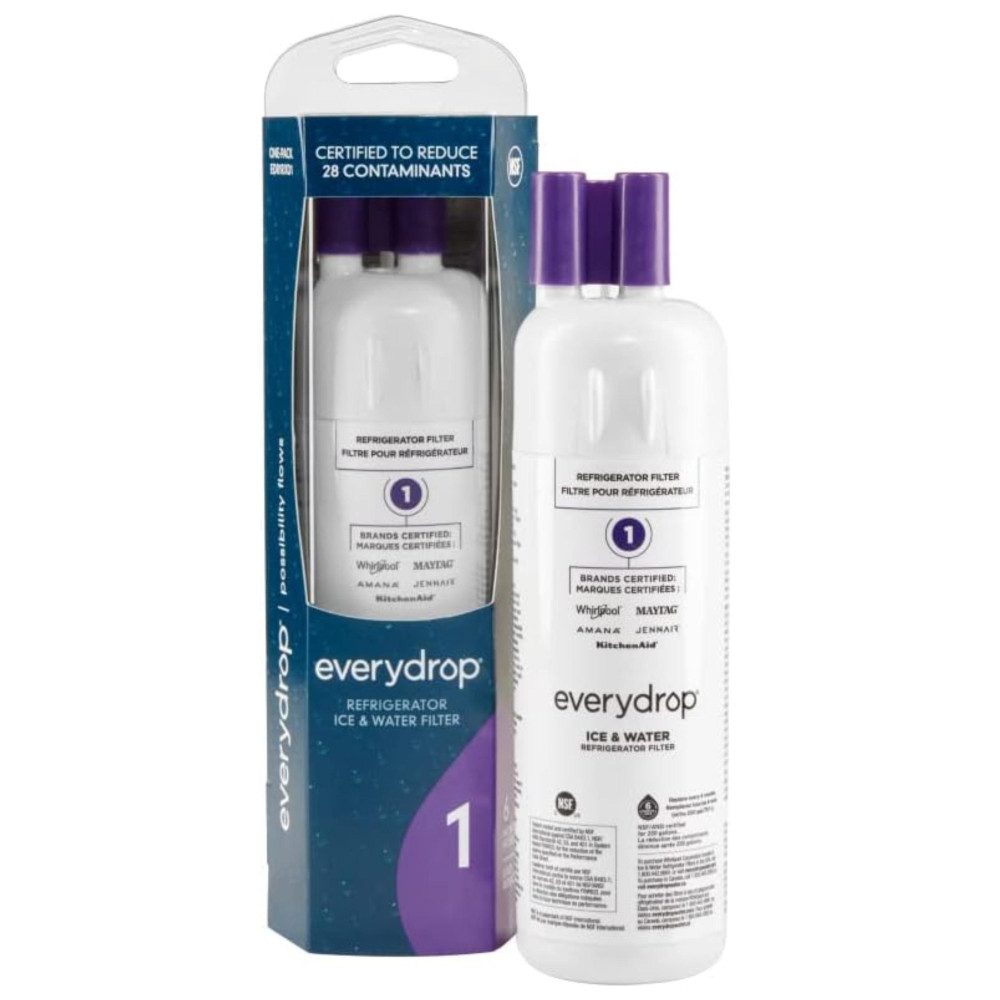
EveryDrop by Whirlpool Refrigerator Water Filter 1 (EDR1RXD1)
Fridge replacement filter
Price last checked during our buy audit; current price may differ. Affiliate links.
Generic vs OEM: what to actually check
When you're considering a generic EDR1RXD1-compatible cartridge, the meaningful questions are:
1. Is it NSF/WQA certified — and against which standards?
This is the single most important check. Three possible answers:
- Certified by NSF or WQA — listed in either WQA Gold Seal or NSF DWTU under the generic brand's name. Search by the generic brand (Waterdrop, Aqua Fresh, Tier1, AquaCrest, etc.) and look for fridge-filter SKUs.
- "Tested to NSF/ANSI X standard" — the manufacturer ran some testing using the protocols but didn't pursue third-party certification. Legitimate but a weaker claim than full certification.
- No third-party cert claim at all — the listing relies on "fits Whirlpool EDR1RXD1" compatibility and customer reviews. This tells you the form factor matches; it tells you nothing about whether the cartridge filters the same contaminants.
If lead reduction matters to you (older home, lead service line, children, pregnancy), the answer needs to be NSF/ANSI 53 certified, not just NSF/ANSI 42. Don't conflate the two on the box.
2. Which standards does the cert claim cover?
Same as pitcher cartridges, NSF/ANSI 42 vs 53 is the meaningful distinction:
- NSF/ANSI 42 only — chlorine taste and odor reduction. Fine for a "my fridge water tastes weird" complaint. Not fine for lead concerns.
- NSF/ANSI 42 + 53 — chlorine plus lead, cysts, certain VOCs. The OEM EDR1RXD1 carries both; generics that match this profile are the closest substitute.
- More standards (401, 372, etc.) — emerging contaminants and material safety. Less common at this price tier; verify per SKU.
3. Does it physically fit the right model family?
Whirlpool publishes the compatible-model list on the OEM cartridge packaging. Generic cartridges claim compatibility across the same family (or sometimes a different but overlapping family). Two things to watch for:
- EDR1RXD1 vs EDR2RXD1 vs EDR3RXD1 — these are different cartridges for different fridge generations. A generic that fits "EDR2" doesn't fit a fridge that needs EDR1. Match the EDR number on your existing cartridge before ordering.
- Side-by-side vs French-door cartridge differences — even within Whirlpool/KitchenAid/Maytag, some models use slot-in cartridges and others use twist-in cartridges. The EDR1 family is mostly slot-in (top-shelf or back-wall). Check your existing cartridge's mounting style.
4. Manufacturer return policy and recall posture
Generic cartridge manufacturers vary widely in how they handle defective batches. The OEM has a clear recall and replacement path through Whirlpool's customer service. Some generics (especially the higher-profile brands like Waterdrop) have similar customer service infrastructure; others (no-name Amazon listings) often don't. For a product that filters water you'll drink, this matters.
What "tested to NSF" actually means
You'll see "tested to NSF/ANSI Standard 42" or "tested to NSF/ANSI Standard 53" on a lot of fridge-filter packaging. This phrasing is legal but materially weaker than "NSF certified" or "WQA Gold Seal certified." Three possibilities:
- Tested in an NSF-licensed third-party lab (e.g., IAPMO) with the test data on file but the product not submitted to NSF or WQA for full certification listing. Reasonable.
- Tested in-house using NSF/ANSI protocols — the manufacturer ran the testing themselves, no third party verifies. Weaker.
- Tested informally against the standard — sometimes loose marketing language. Weakest.
If a cartridge claims "tested to" without certification listing, the manufacturer should disclose which path applies. If they don't, treat the claim as the weakest of the three.
The honest cost framework
Approximate annual cost ranges across the EDR1 alternatives space, with cert profile attached:
| Tier | Annual cost (1 fridge, 6-month replace) | Typical cert profile |
|---|---|---|
| OEM EveryDrop EDR1RXD1 | $90 – $110 | NSF/ANSI 42 + 53 (verify current SKU on WQA) |
| Premium generics (NSF-certified) | $40 – $60 | NSF/ANSI 42 + 53 — verify the specific brand listing |
| Mid-tier generics ("tested to" claims) | $20 – $35 | Variable; verify the lab and the standards |
| No-cert generics ("fits EDR1RXD1") | $10 – $20 | None claimed; form-factor compatibility only |
The $40-$60 NSF-certified generic tier is where most cost-conscious households with lead concerns should land — half the OEM cost, the same cert profile (verify per product), with the trade-off being slightly less mature customer service for defects.
The bottom $10-$20 tier is a real option if your only concern is chlorine taste AND your CCR shows no lead, no PFAS, no industrial contaminants. For chlorine taste only, any cartridge with carbon and a reasonable flow rate handles it — certification is less critical when the target contaminant is just taste/odor. But for households where the fridge water is used for baby formula or by kids, the cert profile matters and the cheap tier is the wrong call.
Decision walkthrough
- Identify your exact cartridge model. Open the fridge filter housing; the existing cartridge has the EDR number printed on it (EDR1RXD1, EDR2RXD1, EDR3RXD1, etc.). Generic listings claim compatibility with specific EDR numbers — match exactly.
- Identify what you need certified. Lead concern → NSF/ANSI 53 required. Chlorine taste only → NSF/ANSI 42 enough.
- Verify candidate generics in the cert databases. Search the generic brand at WQA Gold Seal and NSF DWTU. If a brand has listings, find the specific SKU and read its certifications.
- Pick the cheapest brand that meets the cert profile you need. Generic price within the NSF-certified tier is mostly differentiated by brand recognition and customer service, not filter performance.
- Watch the replacement cycle. Whether OEM or generic, run cartridges on a 6-month maximum cycle. Cert performance degrades past the rated capacity regardless of brand.
When to upgrade past fridge filtration entirely
Fridge filters are convenient for drinking water at the dispenser but they don't cover cooking, water for pets, or any tap that isn't the fridge. If you're spending $100/year on EveryDrop OEM cartridges, an under-sink filter with similar NSF/ANSI 53 coverage runs $200-$400 upfront + $50-$100/year in replacement cartridges. Cost-parity inside 18-24 months, with filtered water at the actual cooking and drinking taps rather than the fridge dispenser only.
This is especially worth considering if you have multiple fridges, multiple sinks where you use filtered water, or if you cook a lot from filtered water (not just drink it). The Filter Finder routes here when usage volume and concern category support it.
What this guide deliberately doesn't do
- Recommend a specific generic brand by name. Generic cartridge cert profiles change as manufacturers reformulate; what's NSF/ANSI 53 certified this year may or may not be on the same SKU next year. The verification path is the WQA / NSF DWTU search — always check the current listing for any candidate.
- Tell you generics are equivalent to OEM in all respects. They're equivalent in cert profile when properly NSF/WQA listed; they're not equivalent in customer service, recall responsiveness, or warranty support. For households where filter reliability matters (medical condition, infant in the home), OEM has a meaningful customer-service premium that justifies the cost delta.
- Quote prices that will stay accurate. Cartridge pricing on Amazon and at retailers shifts constantly with subscribe-save discounts, multi-pack pricing, and seasonal sales. Use the cost ranges as tier indicators.
See the methodology for how we make recommendations and the affiliate disclosure for how we earn money.
What to do next
- Verify a specific cartridge's certifications: WQA Gold Seal or NSF DWTU — search by brand name.
- Considering under-sink instead of OEM-priced fridge filters? Read pitcher vs under-sink RO and use the Filter Finder.
- Want to understand NSF cert standards in detail? Read NSF/ANSI 42 vs 53 vs 58 vs 401.